ECU Remapping
Custom ECU remapping and engine tuning for all makes and models, written for your exact vehicle, and carried out wherever you are.
Book a remap →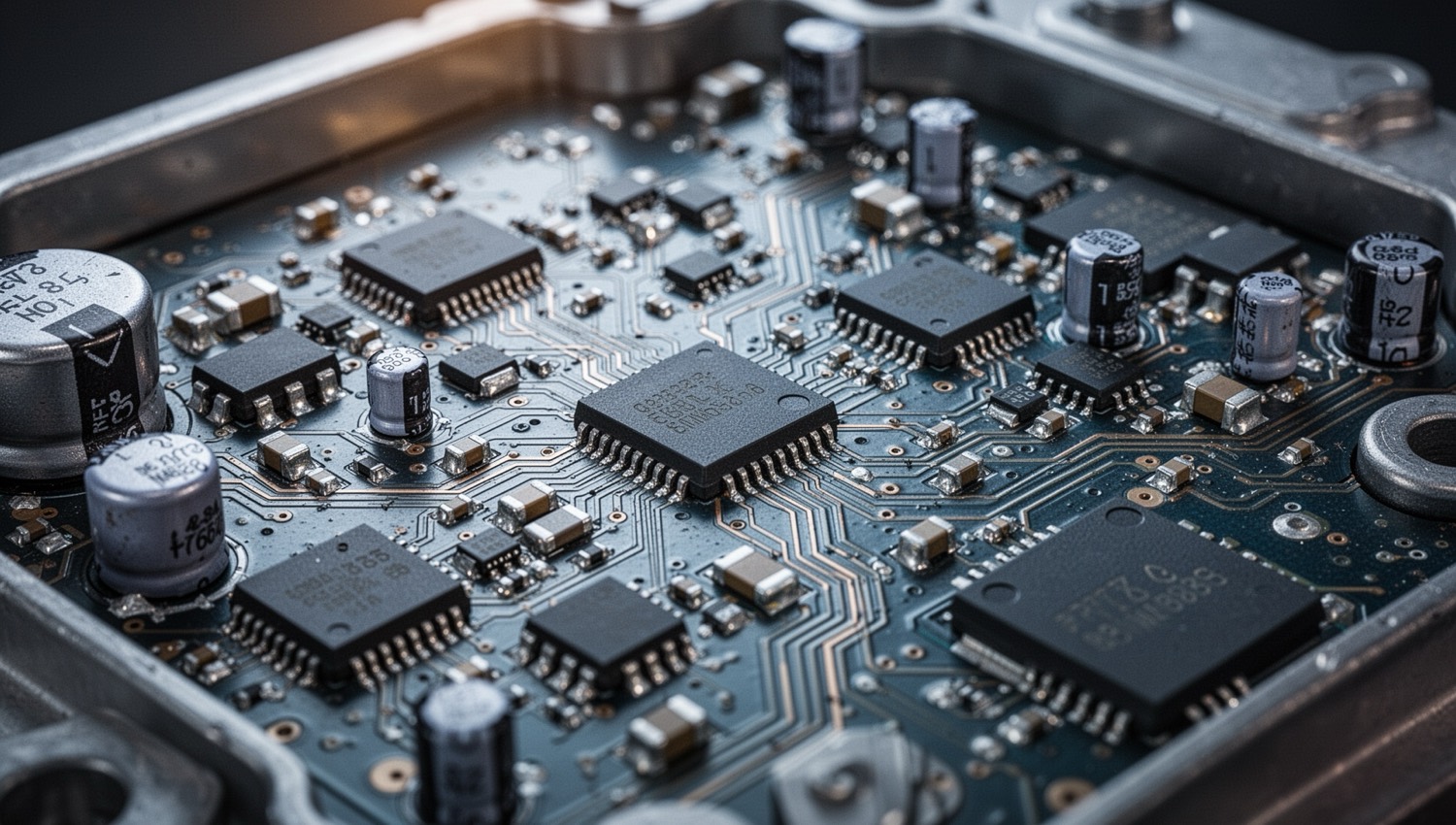
ECU remapping, also called chipping, engine tuning or simply car tuning, means rewriting the software your engine control unit uses to run the engine. It is the single most effective change most owners can make to how a modern car drives, and it needs no mechanical parts at all.
Your ECU leaves the factory with a calibration that has to satisfy every market the model is sold into: varying fuel quality, wildly different climates, different emissions regimes, and the manufacturer’s own need to space models apart in the range. The same physical engine is often sold at two or three different power outputs purely through software.
That means the map in your car was never written for your car, your fuel, or your roads. A properly written custom map is, and that headroom is where the improvement comes from.
A remap is not one setting turned up
People often picture a single dial being wound round. What actually happens is that several calibration tables are adjusted as a set, because they only make sense in relation to each other. Raise the boost without matching the fuelling and you have made the car worse, not better.
That is also why a file written for your exact engine and ECU variant behaves differently to a generic one bought off a shelf. The tables are not interchangeable between variants, even on the same model.
How the job actually runs
We read the software off your ECU, write a map specific to that engine and ECU variant, and write it back. On most modern vehicles this happens through the OBD port while the car sits where it is parked.
, and the car can always be put back to standard.
OBD, bench or boot mode
Not every ECU will hand over its software through the diagnostic socket. Some are locked down and have to be read on the bench or in boot mode, which means the unit comes out of the car to be worked on directly.
Which one applies depends on the ECU itself, not on the badge or the model year, and we confirm it with you before you book rather than turning up and discovering it. Our OBD vs bench remapping guide goes into more detail.
Which map suits you
There is no single best remap. It depends entirely on what you want the car to do.
| Map | Built around | Suits |
|---|---|---|
| Stage 1 | A standard, unmodified vehicle | Almost everyone. The usual starting point. |
| Performance | Power and throttle response | Drivers who want the car to feel quicker |
| Economy | Efficiency and low-down torque | High mileage, vans, motorhomes, towing |
| DSG / gearbox | The transmission, not the engine | Automatics and dual-clutch cars |
Petrol and diesel also respond quite differently. Diesels typically show the biggest torque and economy change, petrols the sharper top end. Our petrol vs diesel guide covers it properly.

Storing your original, and when that is not possible
Most of the time we read the software off your ECU and store it, and that stored file is what goes back on if you ever want the car standard again. It is your file, off your car.
On some vehicles that is not possible. Certain ECUs will accept new software but will not hand over what is already on them, and BMW F-series units done through the OBD port are the well-known example. There the tool reads the software identifier, then pulls the matching factory file from the tool maker’s own database. The tune is applied to that file and written to the ECU. The car’s own software is never read.
The upshot is the same either way: the vehicle can be put back to standard. What differs is whose file that is. On a virtual read it is the manufacturer’s original for that exact software version rather than the one that came off your car.
Worth telling us upfront: if a vehicle has already been tuned, a virtual read cannot preserve that work, because nothing is being read. Whatever was on the ECU is replaced. If your car has been mapped before and you want that kept, say so before you book and we will check whether yours can be read properly.
Mobile across the South West
We come to your home, your work or your yard and do the whole job there, typically in around an hour. You are welcome to come to us by arrangement instead if that suits you better.
No rolling road is needed for the work we do. Our guide on whether you need a rolling road explains why, and where one genuinely does earn its keep.
More power and torque
Unlock the engine's true potential with a calibration tuned to suit your vehicle.
Improved fuel economy
A well-optimised map can reduce fuel consumption, particularly on motorway and A-road driving.
Fully reversible
Your original map is backed up before we begin, restoring factory settings is straightforward.
Petrol and diesel
We work across fuel types and a wide range of makes and models.
Matched to your vehicle
We choose the right map for your car and your goals, not a blanket approach.
Stage 1 Remap
The most popular remap there is, a custom software upgrade for a standard vehicle, with no mechanical changes needed.
Learn more →Stage 2 Remap
For modified vehicles, a map written around the supporting hardware you've already fitted.
Learn more →Stage 3 Remap
Serious, hardware-led tuning for heavily modified vehicles, a conversation before it's a booking.
Learn more →Locked ECU Unlocking: Bosch MD1 and MG1
Bosch MD1 and MG1 ECUs from 2021 onward are locked from the factory. Unlocking used to mean posting the unit away. It no longer does.
Learn more →Frequently asked
Will a remap affect my car insurance?
Yes. You must declare modifications to your insurer. Most insurers accommodate remaps; premiums may change. We recommend checking before booking.
Is ECU remapping safe for my engine?
When done correctly, yes. We keep parameters well within safe limits for your engine's components. We don't push margins that compromise reliability.
How long does a remap take?
Most remaps are completed within 1–2 hours, depending on the service type and vehicle.
Can the remap be removed?
Yes. We store your original ECU file and can return the vehicle to factory settings at any time.
Which manufacturer do you drive?
Every map is written for your exact make, model and engine. Pick yours to see the models we work on most.
Mobile remapping across the South West
We come to you across Weston-super-Mare and the towns right across the region. A few of the areas we cover:
Ready to transform the way you drive?
Call 01934 245246 · info@carbontuning.co.uk